GS-2000 Series is the most widely used fluorescent pigment of all others, having brilliant, strong fluorescent colour, fine particle size and uniform chroma. It is suitable for water and various solvent systems such as paper coating, fabric printing paste, gravure ink, paint, screen printing ink (water base), PVC plastics and colloidal sol. The pigment can also be used in plastics by injection moulding where the processing temperature is below 195°C.
Physical & Chemical Property
| Type | Thermoplastic pigment |
| Specific gravity | 1.36 g/cm3 |
| Avg. particle size | ≤10 μm |
| Softening point | 115-125°C |
| Decomposition point | 200°C |
| Oil absorption | 56 ml/100g |
| Code | Color Shade | Equivalence | |
|---|---|---|---|
| GS-2011 | CERISE | AX 12 | |
| GS-2012 | PINK | AX 11 | |
| GS-2013 | RED | AX 13 | |
| GS-2014 | RED ORANGE | AX 14 | |
| GS-2015 | ORANGE | AX 15 | |
| GS-2016 | ORANGE YELLOW | AX 16 | |
| GS-2017 | STRONG YELLOW | AX 17 | |
| GS-2018 | GREEN | AX 18 | |
| GS-2019 | BLUE | N/A | |
| GS-2021 | MAGENTA | AX 21 | |
GS-3000 series is synthesized by environmental friendly resin of formaldehyde free, having higher color strength, heat resistance, light fastness and good compatibility, suitable for various plastic processing with good mechanical performance. During the production process, there’s no formaldehyde released, no viscosity to screw, no black points. By extending the continuous productive time for screw, shortening the time to wash, predigesting the clean process, it benefits for saving production cost. It is recommended to various plastics for injection, extrusion, blow molding, with heat resistance is up to 280℃.
Physical & Chemical Property
| Type | Thermoplastic pigment |
| Specific gravity | 1.2 g/cm3 |
| Avg. particle size | ≤30 μm |
| Softening point | >130°C |
| Decomposition point | >300°C |
| Heat resistance | 280℃, 5min, PP |
| Code | Color Shade | Equivalence | |
|---|---|---|---|
| GS-3010 | STRONG YELLOW | Z 17 | |
| GS-3011 | GREEN | N/A | |
| GS-3013 | ORANGE | Z 15 | |
| GS-3014 | RED ORANGE | Z 14 | |
| GS-3015 | RED | Z 13 | |
| GS-3018 | PINK | Z 11 | |
| GS-3019 | BLUE | N/A | |
| GS-3021 | MAGENTA | Z 21 | |
Color changes of Thermochromic pigments are induced by temperature change. The pigments are composed by microcapsules that change colors reversibly.
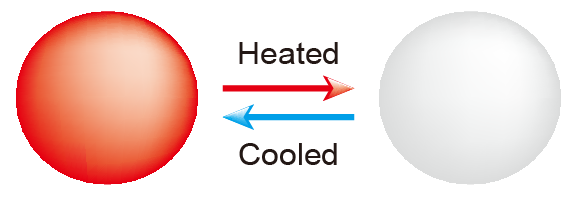
Good dispersibility: With special surface treatment, it could be dispersed well in most carriers, like ink, paint and plastic.
Good heat resistance: It’s stable under 140℃ / 30mins; 200℃ / 10mins.
Good solvent resistance: Insoluble in organic solvent
Water base ink/ paint
Plastic
Available Activation Temperatures: 10-70℃.
Multi color available: 10 standard colors for each activation temperature. Yellow, Red, Pink, Magenta, Royal Blue, Yellowish Green, Green, Bluish Green, Brown, Black. Beside this, all the colors can be mixed with each other or added other pigments.
Available Activation Temperatures: 60-65℃.
Multi color available: Magenta, Blue, Green, all the colors can be mixed with each other or added other pigments.
A. Match any color as your expect. You may mix different colors of thermochromic pigments with the same temperature to create more colors.

B. Two-phase Color Change. They also can be mixed with regular pigments, so that the color can be changed from one to another. At lower temperature, the color reveals matched shade. When the temperature is increased, the thermochromic pigment start fading to colorless. It only shows color of the regular pigments.
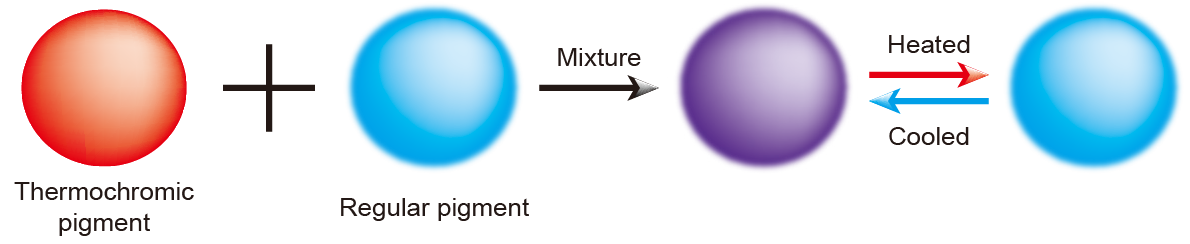
C. Multi-phase Color Change. By mixing the thermochromic pigments with different temperature ranges, the color can be varied for more than two colors.

Avoid dispersing by high-speed shearing machine, like ball-grinding machine, sand-milling machine, three-rolling machine, etc. Otherwise, the protection layer may be destroyed and lose the effecting.
Avoid processing with high temperature (>230℃).
For printing inks / paint, it is recommended to adjust the pH value of resin between 5-8.
Avoid using toluene as single solvent. If the formulation is a mixed solvent, less toluene is recommended.
The photochromic pigment changes colors when exposed to sunlight/UV, and reverts to its original color when the sunlight/UV is dimmed or blocked. After absorbing the energy of sunlight/UV, its molecular structure is changed, which causes its absorbed wavelength to be changed allowing a color to appear. It reverts to the original molecular structure and color when the light stimulus is dimmed or blocked.
 Colorless(without UV)
 Red Colored(with UV)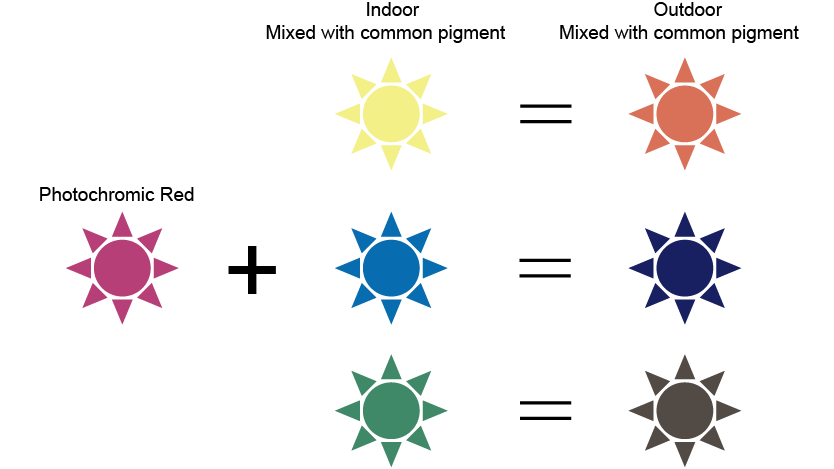
- COATING, like PMMA painting, ABS painting, PVC painting and waterbased painting. Recommend pigments concentration is 10%-30%.
- INK, like fiber, paper, foil and glass printing ink. Recommend pigments concentration is 20%-40%.
- Plastic Injection/Extrusion, like PE masterbatch, PMMA masterbatch, Recommend pigments concentration is 0.8-3%.
- The photochromic pigment does not react to sunlight/UV and need to be dissolved in a medium(solvent, resin, or polymer) to function. Polarity of the medium is directly related to the color.
- Overexposure to sunlight, acids, free radicals and humidity may cause poor fastness, which could be improved by adding UV absorbing or anti-oxiants.
- Specific formulations of UV absorbents or anti-oxidants should be used depending on the media.Improper formulations speed destroying color fastness and end up destroying the color changing properties.
- Highest heat resistance of photochromic pigment is 250℃
- The photochromic pigments do not contain heavy metals which are harmful to people. They are comply with toy and food packaging standard.
The photochromic pigment changes colors when exposed to sunlight/UV, and reverts to its original color when the sunlight/UV is dimmed or blocked. After absorbing the energy of sunlight/UV, its molecular structure is changed, which causes its absorbed wavelength to be changed allowing a color to appear. It reverts to the original molecular structure and color when the light stimulus is dimmed or blocked.
Colorless(without UV) Yellow Colored(with UV)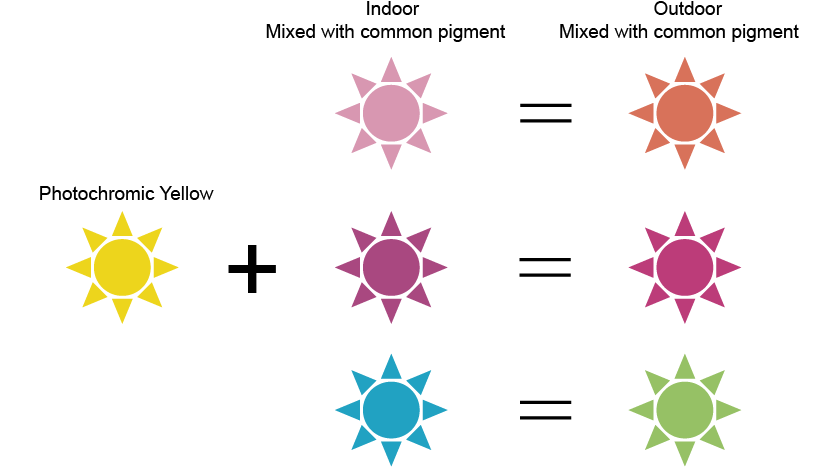
- COATING, like PMMA painting, ABS painting, PVC painting and waterbased painting. Recommend pigments concentration is 10%-30%.
- INK, like fiber, paper, foil and glass printing ink. Recommend pigments concentration is 20%-40%.
- Plastic Injection/Extrusion, like PE masterbatch, PMMA masterbatch, Recommend pigments concentration is 0.8-3%.
- The photochromic pigment does not react to sunlight/UV and need to be dissolved in a medium(solvent, resin, or polymer) to function. Polarity of the medium is directly related to the color.
- Overexposure to sunlight, acids, free radicals and humidity may cause poor fastness, which could be improved by adding UV absorbing or anti-oxiants.
- Specific formulations of UV absorbents or anti-oxidants should be used depending on the media.Improper formulations speed destroying color fastness and end up destroying the color changing properties.
- Highest heat resistance of photochromic pigment is 250℃
- The photochromic pigments do not contain heavy metals which are harmful to people. They are comply with toy and food packaging standard.
The photochromic pigment changes colors when exposed to sunlight/UV, and reverts to its original color when the sunlight/UV is dimmed or blocked. After absorbing the energy of sunlight/UV, its molecular structure is changed, which causes its absorbed wavelength to be changed allowing a color to appear. It reverts to the original molecular structure and color when the light stimulus is dimmed or blocked.
Colorless(without UV) Blue Colored(with UV)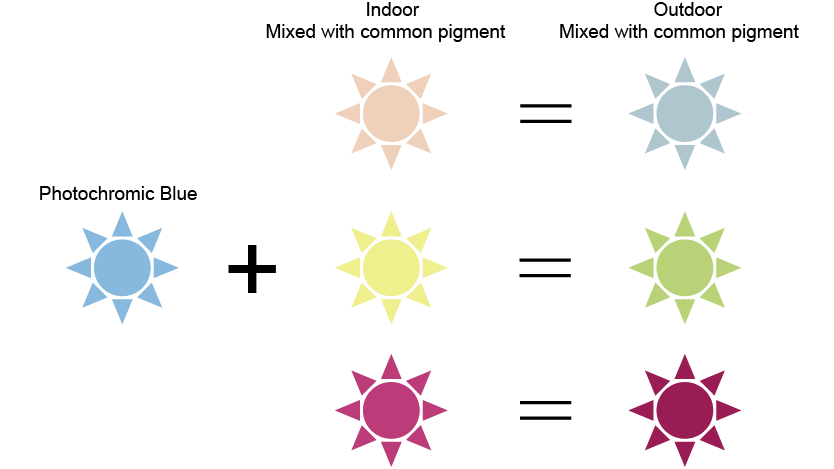
- COATING, like PMMA painting, ABS painting, PVC painting and waterbased painting. Recommend pigments concentration is 10%-30%.
- INK, like fiber, paper, foil and glass printing ink. Recommend pigments concentration is 20%-40%.
- Plastic Injection/Extrusion, like PE masterbatch, PMMA masterbatch, Recommend pigments concentration is 0.8-3%.
- The photochromic pigment does not react to sunlight/UV and need to be dissolved in a medium(solvent, resin, or polymer) to function. Polarity of the medium is directly related to the color.
- Overexposure to sunlight, acids, free radicals and humidity may cause poor fastness, which could be improved by adding UV absorbing or anti-oxiants.
- Specific formulations of UV absorbents or anti-oxidants should be used depending on the media.Improper formulations speed destroying color fastness and end up destroying the color changing properties.
- Highest heat resistance of photochromic pigment is 250℃
- The photochromic pigments do not contain heavy metals which are harmful to people. They are comply with toy and food packaging standard.
The photochromic pigment changes colors when exposed to sunlight/UV, and reverts to its original color when the sunlight/UV is dimmed or blocked. After absorbing the energy of sunlight/UV, its molecular structure is changed, which causes its absorbed wavelength to be changed allowing a color to appear. It reverts to the original molecular structure and color when the light stimulus is dimmed or blocked.
Colorless(without UV) Purple Colored(with UV)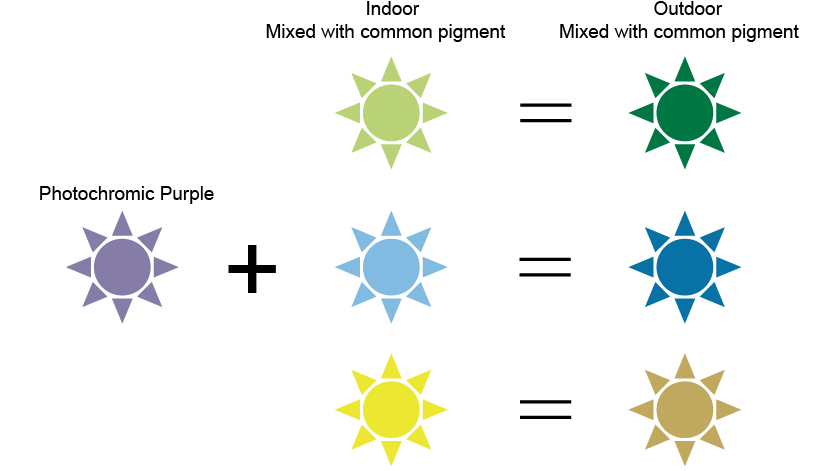
- COATING, like PMMA painting, ABS painting, PVC painting and waterbased painting. Recommend pigments concentration is 10%-30%.
- INK, like fiber, paper, foil and glass printing ink. Recommend pigments concentration is 20%-40%.
- Plastic Injection/Extrusion, like PE masterbatch, PMMA masterbatch, Recommend pigments concentration is 0.8-3%.
- The photochromic pigment does not react to sunlight/UV and need to be dissolved in a medium(solvent, resin, or polymer) to function. Polarity of the medium is directly related to the color.
- Overexposure to sunlight, acids, free radicals and humidity may cause poor fastness, which could be improved by adding UV absorbing or anti-oxiants.
- Specific formulations of UV absorbents or anti-oxidants should be used depending on the media.Improper formulations speed destroying color fastness and end up destroying the color changing properties.
- Highest heat resistance of photochromic pigment is 250℃
- The photochromic pigments do not contain heavy metals which are harmful to people. They are comply with toy and food packaging standard.
GS-4000 Series fluorescent pigments are thermosetting resin based pigments with high tinting strength and strong solvent resistance. They are suitable for C?type gravure inks, coatings, spray paints, PVC organosols, water?based emulsion paints and natural rubber applications.
Physical & Chemical Properties
| Type | Thermosetting pigment |
| Specific gravity | 1.36 g/cm3 |
| Avg. particle size | ≤15 μm |
| Decomposition temperature | 230°C |
| Oil absorption | 56 ml/100g |
| Code | Color Shade | Equivalence | |
|---|---|---|---|
| GS-4010 | Violet | N/A | |
| GS-4011 | Rose | T 12 | |
| GS-4012 | Pink | T 11 / GT 11 | |
| GS-4013 | Red | T13 / GT 13 | |
| GS-4014 | Red Orange | T14 / GT 14 | |
| GS-4015 | Orange | T15 | |
| GS-4016 | Orange Yellow | T16 | |
| GS-4017 | Lemon Yellow | T 17 / GT 17 | |
| GS-4018 | Green | T 18 | |
| GS-4019 | Blue | T 19 | |
| GS-4020 | White | N/A | |
| GS-4021 | Magenta | GT 21 | |
GS-5000 Series fluorescent pigments are fully soluble in solvents and provide excellent transparency. They are suitable for formulating solvent?based relief and gravure printing inks, and can be used for printing on packaging papers, transparent films, and aluminum foil surfaces. They are also suitable for UV?curing ink formulations.
Physical & Chemical Properties
| Type | Thermoset pigment |
| Specific gravity | 1.36 g/cm3 |
| Recommended solvent | MEK, Ethyl Acetate |
| Code | Color Shade | Equivalence | |
|---|---|---|---|
| GS-5010 | LEMON YELLOW | N/A | |
| GS-5012 | PINK | HM-11 | |
| GS-5013 | RED | HM-13 | |
| GS-5014 | RED ORANGE | HM-14 | |
| GS-5015 | ORANGE | HM-15 | |
| GS-5016 | ORANGE YELLOW | N/A | |
| GS-5017 | STRONG YELLOW | HMS-34 | |
| GS-5018 | GREEN | N/A | |
| GS-5019 | BLUE | N/A | |
| GS-5020 | VIOLET | N/A | |
| GS-5021 | MAGENTA | HMS-30 | |